
Enterprise Resource Planning (ERP) platforms are shedding their legacy reputation as passive, backwards-looking databases. Where traditional deployments trapped operational data across siloed tables and forced teams into reactive reconciliation cycles, 2026 architectures embed machine learning, predictive analytics, and autonomous multi-agent systems directly into day-to-day business logic.
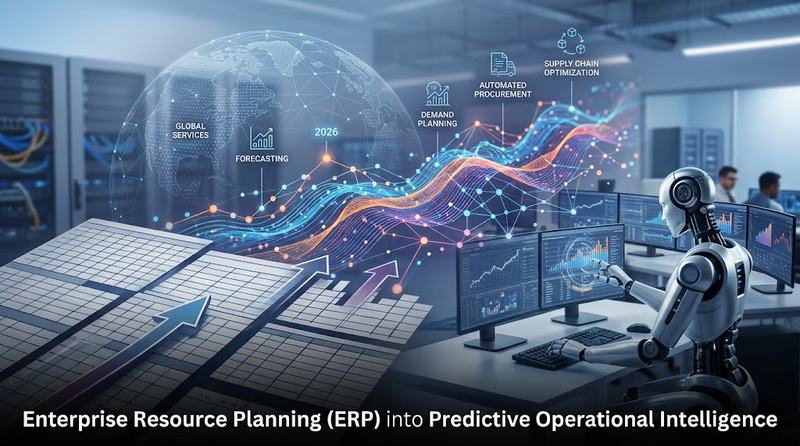
Recent production deployments across platforms like Microsoft Dynamics 365 illustrate the measurable impact of this transition:
- Compressed Planning Cycles: Poloplast cut operational planning runtimes from hours down to roughly 60 seconds through automated processing engines.
- Paperless Demand Forecasting: Domino’s UK achieved 99.8% inventory availability across 1,400 stores using continuous predictive modeling.
- Autonomous Procurement: Farmlands Cooperative automated half of its purchase order communications via agent-driven communication workflows.
What stands out is the architectural shift from retrospective record-keeping to forward-looking decision support. An intelligent ERP does not merely render a dashboard of historical ledger lines; it models supply disruptions, working-capital deficits, and demand anomalies well before they impact operations. The strategic risk equation has inverted: the danger is no longer the upfront investment required to modernize, but the compounding technical and operational debt of maintaining fragmented systems while competitors execute on real-time intelligence.
This transition highlights a core truth in building scalable backend systems, data pipelines, and automation tools: model intelligence is only as dependable as the pipeline behind it. Building robust enterprise infrastructure requires clean data schemas, deterministic constraints, and modular services that let predictive pipelines interoperate cleanly with core business rules. Upgrading ERP systems to an AI-first standard transforms enterprise software from a simple digital filing cabinet into an active, self-optimizing engine.
References